

Hi friends,
Earlier this month I had the pleasure of speaking at the PHAIR 2025 Animal Advocacy Conference in Edinburgh, where I presented as part of the Animals in Art and Media session. The day was full of rich discussion, creative intersections, and outstanding vegan food.
What struck me most was the range of expertise on show. Researchers and practitioners were drawing connections across art, linguistics, communication, and activism. There were thoughtful critiques of how animals are represented in books, on the radio, and through creative practice. It was a reminder that meaningful change often emerges where disciplines meet.
In my talk, Performing Advocacy: The Transformative Role of Performance in Reframing Human–Animal Relations, I explored how works like Duck Lake and Soya the Cow use site-specific drag, affect, and ritual to cultivate interspecies empathy. These practices provoke ethical reflection not through facts alone, but through embodiment and emotional engagement.
Alongside my presentation were several powerful contributions, including:
Bridget Irving on ecolinguistics and illustration, using picture books and drawings of octopuses to challenge dominant narratives and depict other animals on their own terms.
Bronwen Wilson on speciesist language in BBC Radio 4’s You & Yours, offering critical reflections on how casual language choices reinforce harmful hierarchies.
Augusta Gaspar on what kinds of media lead to actual behaviour change, showing that empathy and belief in animal minds are stronger predictors than age or gender.
These ideas lingered with me long after the session ended. And they connected perfectly to a large-scale study I’ve been reading, by Animal Think Tank; one that digs deep into the emotional and persuasive impact of imagery in animal advocacy.
The study: 7,000 participants, 4 experiments
The paper, Image and Slogan Message-Testing (Animal Think Tank, 2025), involved over 7,000 participants across four experimental conditions. Researchers tested how different combinations of:
visual imagery (idyllic versus distressing),
message tone (direct, soft, or transitional), and
narrative framing
shaped people’s emotional reactions, message retention, and willingness to support animal freedom.
This is valuable not just for campaigners designing posters or leaflets, but for those of us using performance, storytelling, and visual composition to reach audiences on a deeper level.
Key findings
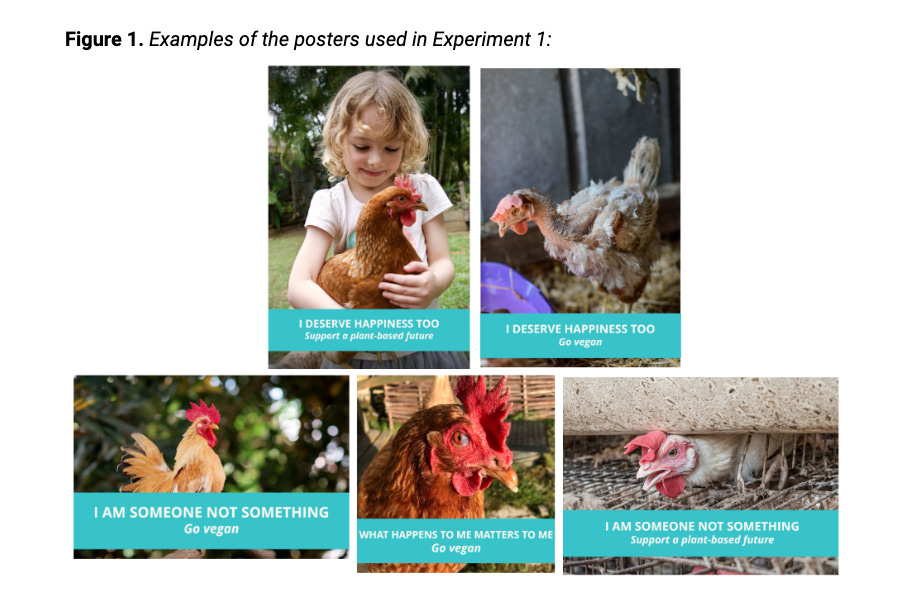
1. Distress works, but connection matters more
The most emotionally impactful images were those showing animals in distress; injured, confined, or suffering. These visuals generated strong reactions, including sadness, disgust, and urgency.
However, the researchers found that the most consistent predictor of persuasion was not sadness or shock. It was empathy; in particular, when people felt:
a sense of similarity to the animals depicted,
emotional kinship or connection, or
that animals were individuals with perspectives
they were more likely to support animal liberation messages.
2. Juxtaposition enhances impact
Pairing distressing images with peaceful or “natural” ones had a striking effect. This contrast helped:
expose "welfare washing",
reveal contradictions in public narratives, and
highlight the tension between marketing and reality.
In performance, similar dramaturgical contrasts, between calm and rupture, lightness and grief, can guide audiences through emotional complexity without overwhelming them.
3. Messaging style influences both clarity and trust
The study tested three common slogans:
“Go vegan” was the most clear and motivating, but also seen as more emotionally forceful.
“Support a plant-based future” was more agreeable, yet less directive.
“Support a transition away from farming animals” felt gentle and palatable, but lacked clarity or urgency.
This highlights the importance of context. What works for a chant on the street may not work in a reflective theatre piece. Performance allows us to weave tone, symbolism, and rhythm into a slower unfolding of meaning.
Performance takeaways
So, what does this mean for the performing animal rights space? Here are a few reflections:
Emotion is essential
Facts alone rarely shift deeply held beliefs. Performance activates feeling; through presence, imagery, rhythm, and relationality.
Contrast carries weight
Moments of tension, silence, or visual dissonance can open space for ethical reflection. Too much trauma imagery risks shutdown. But placed in relation to softness or vision, it becomes part of a dynamic whole.
Empathy and kinship over pity
Audiences are moved when they relate to animals as subjects, not symbols. Characters like Soya the Cow or imagined farmed animals in musicals work because they offer perspective and possibility, not just victimhood.
Message tone should match the setting
The slogan matters, but so does the delivery. A performance can build intimacy, offer complexity, and let audiences reach conclusions themselves.
Know your audience
Some people lean in. Others recoil. Not everyone will be moved the same way. That’s why creative strategies need flexibility, curiosity, and care.
📚 If you want to explore the full study:
Animal Think Tank, 2025: Image and Slogan Message-Testing (PDF)
🔗 For more:
Visit the Performing Animal Rights blog archive
Listen to my podcast interviews with Yvette Watt (Duck Lake), Daniel Hellmann (Soya the Cow), and the latest episode with Lauren-Mare Kennedy
As always, thank you for being part of this creative community. Let’s keep finding ways to reach people; not just with information, but with feeling, imagination, and care.
With warmth,
Ben