

Before I get into the long (long) grass: last month, I had the pleasure of joining the wonderful Our Hen House podcast to talk about theatre, performance and the possibilities of creative animal advocacy. I thoroughly enjoyed the conversation, particularly the opportunity to explore how artistic practices might challenge the ways we perceive, represent and relate to other animals. You can watch our conversation here.
One question that has stayed with me since is how we navigate the complicated business of speaking on behalf of other species. It’s something that sits at the heart of my research, but has taken on a rather different dimension recently through my encounter with the experimental music of composer Hero Douglas. Her work and PhD dissertation has left me thinking less about what artists might say for other animals, and more about what happens when their voices begin to shape the artistic language itself.
There is a phrase that appears frequently within animal advocacy that I have become increasingly uncomfortable with: giving a voice to the voiceless. It is generally offered with the best of intentions, suggesting that those who have been marginalised, silenced or subjected to injustice might finally be heard through the interventions of others. Within some animal rights activism, it has become something of a rallying cry, describing the responsibility humans might assume in speaking on behalf of animals who cannot participate in our political institutions, public debates or systems of representation.
Yet there is an uncomfortable assumption contained within this expression. Other animals are not voiceless. They call, sing, cry, communicate and express themselves through extraordinarily diverse forms of vocal and bodily communication. Their voices already exist, whether or not we recognise their meaning. The problem, perhaps, is not that animals lack voices, but that humans have constructed social, political and economic arrangements in which those voices are so frequently disregarded.
This distinction becomes particularly interesting when we consider the performing arts. Theatre, music and performance have long been celebrated for their capacity to make marginalised experiences visible and audible. Actors inhabit unfamiliar perspectives, composers give musical expression to political struggles, and performers use their bodies to communicate experiences that might otherwise resist conventional language.
But what happens when the subject of these artistic interventions belongs to another species?
What does it mean for a human performer to reproduce the voice of an animal, and can that process communicate something meaningful without claiming to speak on the animal’s behalf?
I have been thinking about these questions while reading the doctoral research of composer and musician Hero Douglas, whose 2026 thesis, A Voice for the Voiceless: Amplifying the Silent Victims of Environmental Injustice, explores how musical composition might respond to animal exploitation and environmental destruction. Douglas’s research spans contemporary classical music, popular song and musical theatre, including Mad Cow, a musical addressing the meat and dairy industries (premiering at The Garlinge Theatre), and several experimental vocal compositions. What particularly captured my attention, however, was her work on Cattle Class, a composition that draws upon the recorded vocalisations of farmed animals to develop new possibilities for human vocal performance.
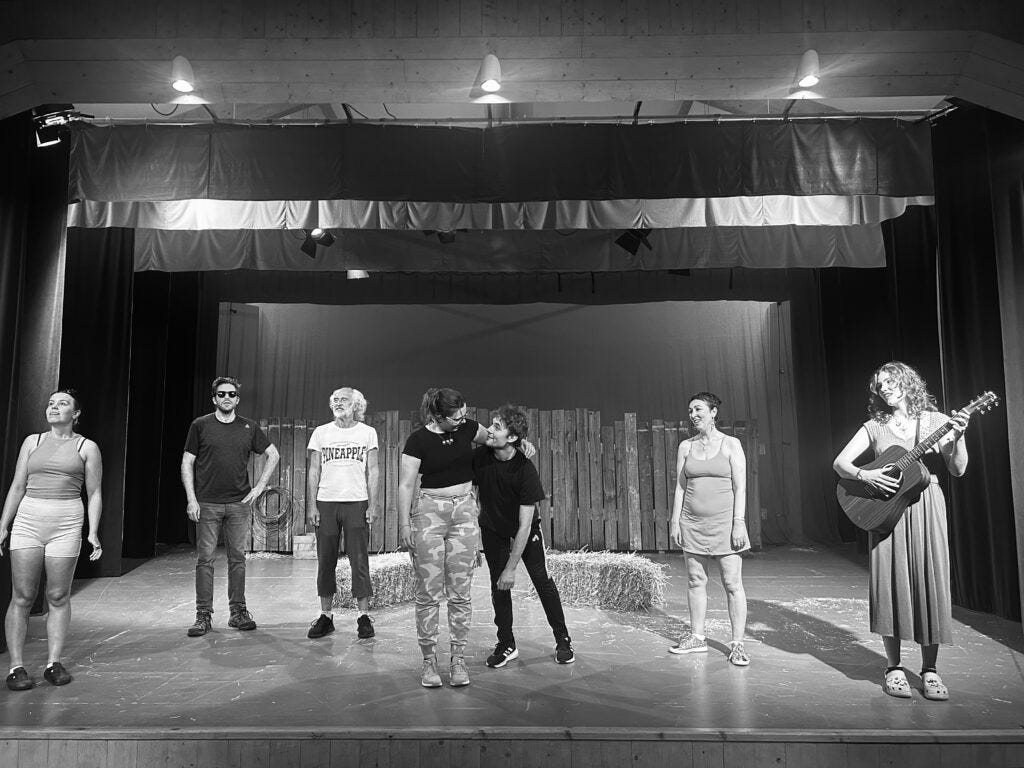
It is an intriguing artistic proposition. Rather than simply writing lyrics about animal suffering, Douglas asks what might happen when the sounds of other animals become part of the musical vocabulary itself. The human voice is stretched beyond conventional singing and speech, becoming a site of experimentation in which animal vocalisations are studied, imitated and transformed into performable musical gestures.
What interests me is not necessarily whether a human singer can convincingly sound like a cow or chicken. I find myself more interested in what the process does to the conventions of performance, to the body producing those sounds, and to an audience accustomed to hearing certain voices as music and others as little more than background noise.
The voice beyond language
One of the most interesting aspects of Douglas’s research is how her creative direction emerged through an encounter with an established theatrical production. While performing in the National Theatre’s 2022 production of The Crucible, which featured music by Caroline Shaw, Douglas became increasingly interested in experimental approaches to vocal performance. Shaw’s compositional techniques, alongside the work of Meredith Monk, encouraged her to reconsider the possibilities of the human voice beyond conventional melody and text.
This places Cattle Class within a fascinating tradition of vocal experimentation.
Throughout the twentieth and twenty-first centuries, composers and performers have challenged assumptions about what the singing voice is supposed to do. Artists such as Cathy Berberian, Joan La Barbara and Meredith Monk have explored vocal sounds that sit uneasily within conventional distinctions between music, speech and noise. Breathing, whispering, crying, vocal percussion, unfamiliar resonances and apparently non-musical utterances can all become compositional material.
Meredith Monk’s work is particularly interesting in this respect. Her performances frequently approach the voice as something more than a vehicle for conveying linguistic meaning. Vocal expression becomes physical, rhythmic, emotional and theatrical, capable of communicating through qualities that resist easy translation into words.
Douglas identifies Monk’s Panda Chant as an important influence on her own experimentation, particularly its use of syllabic sounds, rhythmic articulation and layered vocal textures. Rather than treating music as an arrangement of beautiful notes supporting recognisable language, this approach allows the voice to operate as an expressive material in its own right.
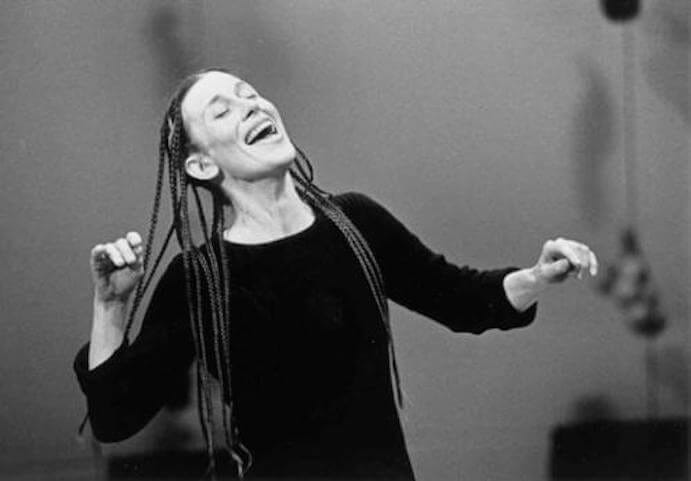
There is something especially compelling about bringing this tradition into conversation with animal advocacy. Humans have developed elaborate cultural distinctions between the singing voice and the sounds produced by other species. A human vocalisation might be understood as artistic expression, while a comparable sound produced by a farmed animal is more readily interpreted as a biological function or an incidental feature of agricultural life.
Of course, these differences cannot simply be dismissed. Music is shaped by cultural practices, traditions, intentions and systems of interpretation. But the distinction between meaningful human expression and supposedly inarticulate animal noise deserves greater scrutiny.
If experimental vocal performance has spent decades challenging the boundaries between music and noise, might it also provide an opportunity to interrogate the boundaries through which human and nonhuman voices are valued differently?
Composing with animal voices
Douglas’s approach to Cattle Class began not in a recording studio, but in a cattle barn. She describes spending time observing animals, documenting their behaviour and recording their vocalisations before returning to her studio to analyse the sounds and experiment with reproducing them through her own voice.
This process strikes me as particularly significant because it begins with attention to actual nonhuman animals, rather than relying solely on familiar cultural representations of them. The cow is not simply a symbolic figure or an imagined theatrical character. The animal’s existing vocal expression becomes the starting point for a compositional investigation.
From these encounters, Douglas developed a series of experimental vocal techniques that translate elements of animal sound into musical gestures. These include descending vocal swoops that open into vowels, humming with puffed cheeks, rhythmic breathing, repeated nasal syllables, quivering vocal sounds and percussive patterns suggesting the clucking of chickens.
Such techniques transform the human voice into something both familiar and unfamiliar. It remains recognisably human, produced through the same breath, vocal folds and resonating body as ordinary singing, yet it moves away from the conventions through which audiences generally recognise human musical expression.
I find the distinction between imitation and translation particularly useful here.
An imitation attempts to reproduce a recognisable sound.
A translation, meanwhile, inevitably involves choices about what can be carried across from one expressive system into another, what must change, and what may be lost in the process.
Douglas’s vocal experiments might be understood as occupying an uncertain space between these activities. The compositional gestures originate in animal vocalisations, but they are transformed through the technical possibilities of the human voice, the conventions of musical notation and the artistic decisions of the composer.
The resulting performance is therefore neither an authentic animal vocalisation nor simply an arbitrary musical invention. It is an encounter between the expressive capacities of different bodies, mediated through artistic practice.
And perhaps this is where the political possibilities begin to emerge.
By introducing sounds associated with farmed animals into contemporary vocal composition, Cattle Class potentially unsettles the expectations through which audiences distinguish human artistic expression from other animal communication. Sounds that might otherwise be ignored or dismissed become the subject of deliberate musical attention.
They are rehearsed, structured, performed and listened to as part of an artistic encounter.
Yet this also raises an important question. Does incorporating animal vocalisations into human musical traditions elevate their significance, or does it imply that those sounds only become worthy of attention once transformed into something recognisably artistic?
I suspect the answer is not straightforward. Indeed, the productive tension between these possibilities may be one of the most interesting features of the work.
The politics of artistic translation
The question of who has the authority to represent another has occupied theatre and performance studies for decades. Actors, directors and dramaturgs continually negotiate the ethical implications of speaking from perspectives beyond their own experiences, particularly when representing individuals or communities who have historically been excluded from cultural production.
In nonhuman animal-centred performance, these questions acquire a further complexity.
The human performer can reproduce certain features of another animal’s behaviour, but the meaning of that behaviour cannot simply be transferred into the performance. A cow’s vocalisation exists within a particular bodily, social and environmental context. Removed from that context and incorporated into a musical composition, it necessarily acquires new associations.
This is not inherently problematic. Artistic practices routinely transform existing sounds, gestures and experiences into unfamiliar expressive forms. Indeed, much of their imaginative potential depends upon that capacity.
However, the transformation is not politically neutral.
When a composer incorporates the sounds of another animal into a work, decisions are made about which aspects of those sounds should be preserved, emphasised, modified or discarded. The animal cannot determine how their vocalisation will be represented, and the resulting artistic expression remains under human control.
This presents an interesting complication for the familiar ambition of giving animals a voice. An artwork might seek to amplify nonhuman expression while simultaneously replacing an animal’s actual vocalisation with a human interpretation of it.
But perhaps demanding complete fidelity is asking the wrong thing of artistic performance.
A theatrical representation of another individual does not become valuable solely because it reproduces that person’s behaviour with documentary accuracy. Performance can also reveal the interpretative processes through which representation takes place, inviting audiences to question what is being shown and how it has been constructed.
Similarly, the value of experimental nonhuman animal-centred vocal work might lie not in convincing us that a human performer has become an animal, but in making the relationship between human interpretation and animal expression more perceptible.
The gaps, distortions and transformations involved in the performance need not be understood as failures. They might instead become part of its artistic significance.
In this respect, I am reminded of the broader questions that have emerged throughout my research into animal representation. We often evaluate nonhuman animal-centred performances according to their apparent capacity to make other species understandable, familiar or emotionally accessible to human audiences. Yet I wonder whether some of the most interesting artistic possibilities emerge when performance resists that expectation, allowing nonhuman lives to remain partially unfamiliar rather than attempting to resolve every difference through identification.
There is also something important about the performer’s own physical involvement. Experimental vocal techniques require bodies to negotiate unfamiliar patterns of breath, resonance, articulation and muscular control. They challenge habitual ways of producing sound, making the process of vocal expression unusually noticeable.
The human voice, so frequently treated as a transparent instrument of communication, becomes strange to itself.
This does not grant performers access to another animal’s experience, but it can complicate their relationship with their own expressive capacities. Perhaps the encounter reveals something about the limitations of human communication precisely because those limitations become materially present in performance.
Who decides what deserves to be heard?
One of the most interesting political implications of this work concerns the cultural hierarchies through which we determine which sounds deserve attention.
A bird singing outside a window may be celebrated for its beauty, while the vocalisations of a cow within an agricultural environment are rarely afforded comparable aesthetic consideration.
A distressed dog might provoke immediate concern, while comparable expressions of distress from animals raised for food can be absorbed into the routine sounds of agricultural production.
These distinctions are not simply matters of individual taste. They reflect the social and economic relationships through which different animals are encountered.
Humans are remarkably capable of recognising animal expression while simultaneously organising institutions that disregard the interests being expressed.
The sounds of farmed animals can be studied, categorised and interpreted as indicators of their physical or emotional condition without necessarily challenging the systems that produce those conditions.
This is where I think the performing arts might offer something distinctive.
Artistic listening differs from the forms of listening associated with scientific observation or agricultural management. It does not necessarily begin by seeking to classify a sound, identify its function or extract useful information from it. Instead, musical performance can invite attention towards qualities that are expressive, affective or unfamiliar.
A sound becomes something to encounter rather than simply something to explain.
Of course, this distinction should not be overstated. Scientific research into animal communication has contributed enormously to our understanding of nonhuman lives, while artistic interpretation can just as readily impose reductive meanings upon its subjects. Neither approach possesses an automatic ethical advantage.
Nevertheless, music creates conditions in which the familiar organisation of sound can be interrupted.
A cow’s vocalisation encountered within a contemporary musical composition occupies a different cultural space from the same sound heard within a dairy farm. The listener may no longer be able to interpret it simply as part of the expected agricultural environment. Its transformation into musical material creates an opportunity to reconsider the assumptions through which the original sound was understood.
This does not mean that audiences will necessarily become more concerned for animals, nor that musical experimentation produces a straightforward progression from aesthetic experience to political action.
But it does suggest that artistic form might influence how animal lives become available to our attention.
And that possibility matters.
Beyond speaking for animals
Something that has increasingly interested me throughout my work on performance and nonhuman animal advocacy is the tendency to evaluate artistic interventions primarily according to their capacity to communicate a political message.
We ask whether an audience understood the issue, whether the performance generated empathy, whether attitudes changed, or whether the experience encouraged a particular action.
These are reasonable questions, particularly for artists explicitly concerned with social transformation. Yet they can encourage us to understand performance as a mechanism for delivering information or emotion, rather than as a practice capable of changing the terms through which an issue is encountered.
In my recent reflection on whether activist art needs to be good art, I explored the possibility that aesthetics and ethics are not separate concerns, with artistic form simply serving as a vehicle for an independently established political message. Instead, the formal qualities of an artwork can become part of its ethical activity.
Douglas’s research offers an interesting opportunity to develop this argument further.
The political significance of Cattle Class does not necessarily depend solely upon what the composition tells audiences about farming. It also resides in the artistic decisions through which animal vocalisations become part of the work’s structure and expressive language.
The politics are not simply contained in the subject matter. They operate through the treatment of the voice itself.
I think there is something particularly valuable about this distinction for animal advocacy. When the intention is to communicate the suffering of other animals, artistic experimentation can sometimes appear secondary to the urgency of the political message. Yet the conventions through which we communicate are themselves implicated in how other animals are understood.
If animal-centred art relies exclusively on established forms of human expression, it may unintentionally reproduce the very hierarchies it wishes to challenge. Experimental practice, by contrast, offers opportunities to question those conventions, although novelty alone is certainly no guarantee of ethical progress.
The challenge is to develop artistic forms that do more than illustrate the moral significance of other species.
Perhaps they can also make the boundaries of human expression less secure.
Learning to listen differently
Returning to the phrase that opened this reflection, I wonder whether giving a voice to the voiceless has endured partly because it offers such a reassuring picture of advocacy. It positions the human advocate as somebody capable of granting expression to those who have been denied it, imagining political intervention as the transmission of a voice from one individual to another.
But other animals do not require humans to grant them the capacity for expression. They already communicate through voices, movements, relationships and sensory experiences that exist independently of our recognition.
What remains deeply unequal is the authority granted to those expressions within human institutions and cultural practices.
This is not to suggest that artists should abandon attempts to represent animals or that human advocacy is somehow illegitimate because it necessarily involves interpretation. Rather, it suggests that we might approach such practices with greater awareness of the difference between amplifying another’s expression and claiming to possess it.
Hero Douglas’s Cattle Class provides an intriguing example of how those questions might be explored through artistic practice. By translating elements of animal vocalisation into experimental human performance, the composition challenges conventional expectations about the singing voice and creates an unfamiliar encounter between human musical expression and the sounds of other species.
What makes this particularly interesting is that the artistic process does not simply place animal suffering into an established musical framework. It allows attention to animal voices to inform the development of the music itself.
The encounter changes the artistic vocabulary.
And perhaps that is an especially valuable ambition for animal-centred performance. Rather than simply using theatre and music to communicate familiar ethical arguments, we might allow our encounters with other species to challenge the expressive conventions through which those arguments are made.
There is something quietly radical about that possibility. If the performing arts can make unfamiliar sounds worthy of attention, expose the interpretative decisions involved in representation, and disturb the assumption that meaningful expression must conform to human conventions, perhaps they can contribute to changing not only what we think about other animals, but how we encounter them.
Yet there is an important limit to this optimism. Listening is not inherently liberatory. Humans can hear an animal’s distress, understand something of its significance, and still choose to participate in the systems responsible for producing it. Greater sensitivity does not automatically entail greater responsibility.
The political challenge is therefore not simply to listen more carefully, but to consider what responsibilities emerge from what we hear.
I think the most interesting contribution of nonhuman animal-centred musical experimentation is not that it enables humans to speak more convincingly for other animals, but that it encourages us to question why their existing expressions have so often required human translation before being taken seriously.
After all, the voices were never absent.
Perhaps it is our understanding of what constitutes a voice, and whose expressions deserve an audience, that needs to change.