

Hi friends,
For the last month or so, I’ve been returning to my old dusty theatre books. On the roots of political theatre. Not out of nostalgia, but to ask how their tools might help us shape more effective, ethical, and imaginative strategies for animal rights activism.
What can we learn from the Brechtian alienation effect, or Boal’s insistence that theatre must rehearse revolution? What happens when we bring those ideas into the messy, urgent terrain of animal justice?
There’s no clean transfer. These thinkers, radical though they were, focused on human systems, human voices, and human spectatorship. But their tools weren’t meant to stay static. They were meant to be re-purposed, misused, broken open.
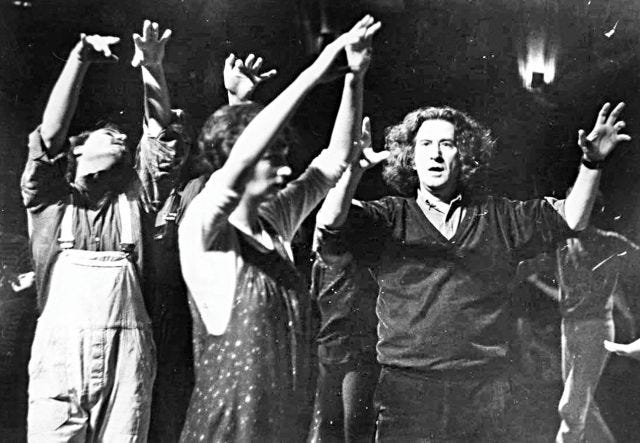
Boal and the ethics of participation
Augusto Boal’s Theatre of the Oppressed begins with one powerful shift: turning the spectator into the spect-actor; a person who sees and acts, who stops being a passive consumer and begins to intervene.
This logic has deep potential in animal activism. It pushes against the static witnessing of suffering and toward embodied participation; not just in art, but in the systems that sustain harm.
But there’s a challenge: Boal’s tools depend on human dialogue. The oppressed speak. They intervene in their own liberation. In the animal context, we’re always working in translation. So, the danger is clear: do we end up speaking for animals, or can we create performances that provoke action without erasing their otherness?
That’s the ethical tightrope. To honour what cannot be directly spoken, without filling in the silence with sentimentality or projection.
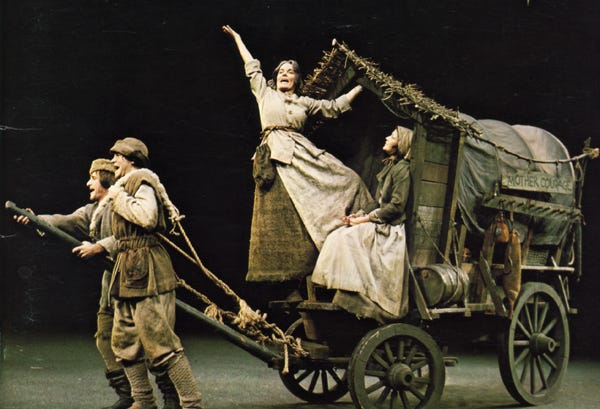
Brecht and the politics of distance
If Boal invites us in, Bertolt Brecht holds us at arm’s length. His concept of Verfremdungseffekt, the alienation or distancing effect, deliberately interrupts emotional immersion to make space for critical thinking. We’re not supposed to cry; we’re supposed to reflect, question, and act.
This is particularly relevant in animal rights performance, where emotional manipulation (often through shock or pity) can trigger guilt, fatigue, or shutdown rather than change. Brecht reminds us that coolness, clarity, and friction are tools too.
In practice, this might look like:
A protest performance that interrupts a public space, demanding attention without asking for sympathy
A piece that refuses neat endings or victim narratives, instead leaving audiences with ethical discomfort
Embodied actions that mirror the audience’s own complicity, without offering instant redemption
But again, the challenge remains: Brecht’s methods rely on audiences identifying with the social contradictions of human life. When animals are represented, we risk either over-humanising them or relegating them to symbolic props. Neither path is ideal.
What about now? Enter Tactical Theatre
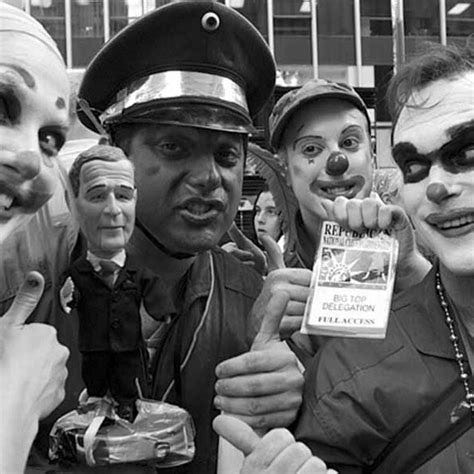
More recently, artists like Larry Bogad have taken up the mantle of political performance and carried it into activist spaces. His concept of “tactical performance” blends theatre, protest, and humour to expose injustice and reframe public discourse.
Bogad’s work with groups like The Clandestine Insurgent Rebel Clown Army, the Yes Men or Billionaires for Bush uses satire, mischief, and disruption as dramaturgy. The goal isn’t moral persuasion; it’s to disorient power.
This feels especially applicable to contemporary animal rights movements, where conventional messaging can feel saturated or stale. A well-timed piece of art intervention, whether comedic, poetic, or surreal, can draw media attention, shift the narrative, and invite passersby to see familiar structures in new ways.
Some provocations to end on
None of these methods provide a perfect template. Boal, Brecht, and Bogad all offer strategies born of human struggle. To apply them in the context of nonhuman liberation is to wade into complicated waters.
Still, they leave us with rich questions to work with:
What does participation look like when the oppressed cannot directly engage?
How can we use distance, interruption, or humour without trivialising suffering?
What forms invite action; not guilt, not pity, but critical, lasting engagement?
Political theatre has always been about shaking the ground beneath the audience’s feet. If we are to use it in animal advocacy, we must also be willing to shake our own assumptions; about voice, presence, audience, and impact.
Best wishes,
Ben