

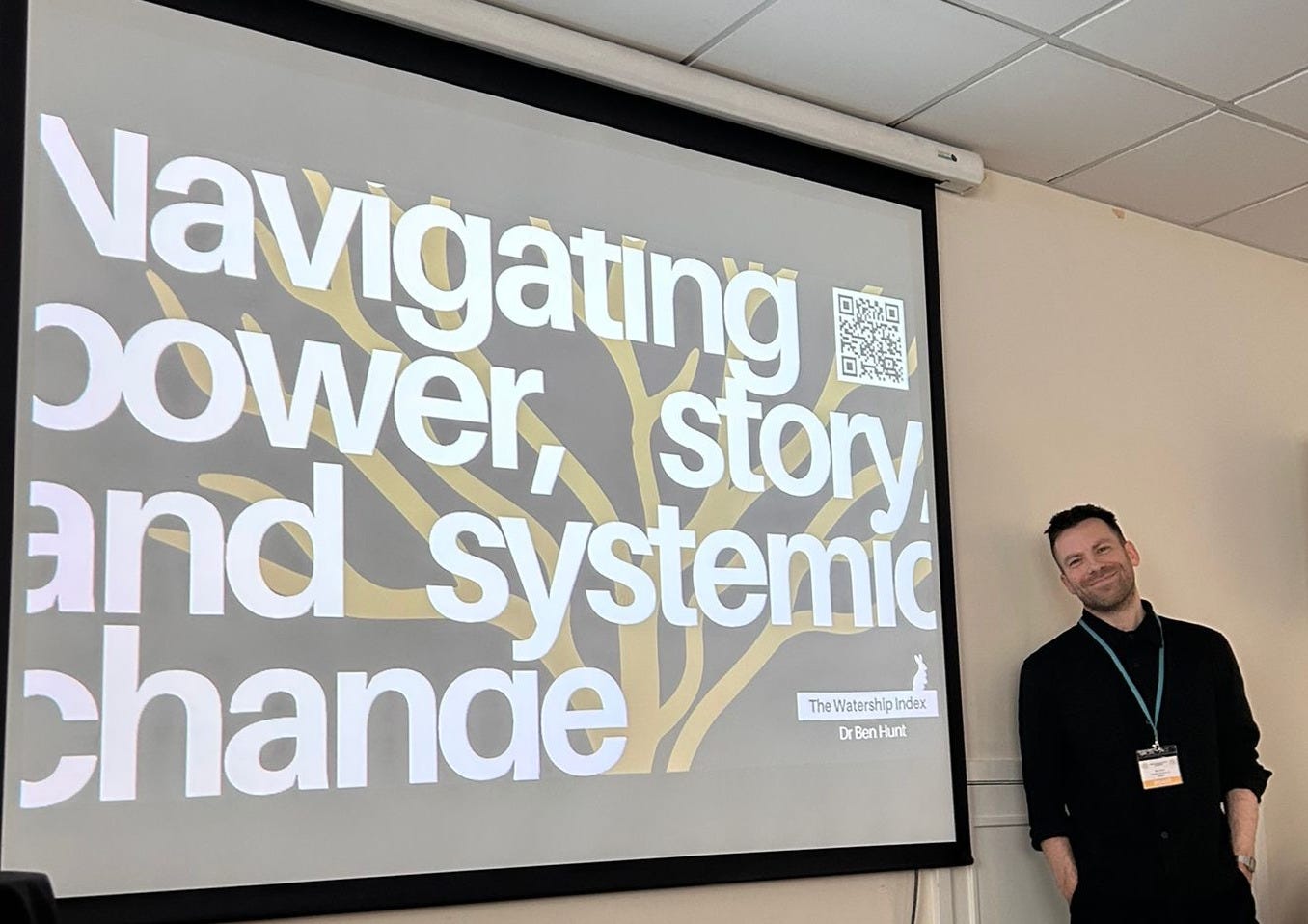
Yesterday I spoke at the Vegan and Animal Rights Conference in Manchester, introducing a narrative and creative framework I’ve been developing called The Watership Index.
You can view the slides from the talk here.
Although the Index is framed as a tool for campaign strategy, it emerges directly from my research into performance, narrative, and animal advocacy.
More specifically, from a question that sits at the centre of both performance and activism:
How is reality being framed, and what does that framing make possible?
In performance, we are constantly working with framing.
What is shown.
What is hidden.
Who is centred.
Who is silenced.
A shift in framing can completely transform meaning, even when the underlying material remains the same.
The same is true in advocacy.
Campaigns do not simply respond to reality.
They actively construct it.
Across the movement, campaign decisions often fall into two broad logics.
On one side, campaigns are prioritised based on scale, tractability, and measurable impact. Corporate cage-free campaigns are a clear example. They target concentrated decision-makers, affect large numbers of animals, and produce tangible outcomes.
On the other side, campaigns are driven by moral clarity and systemic critique. Abolitionist messaging, or calls to end animal farming entirely, sit more clearly here. They aim to reframe exploitation itself.
Both approaches matter. But they are rarely integrated.
This creates a persistent tension.
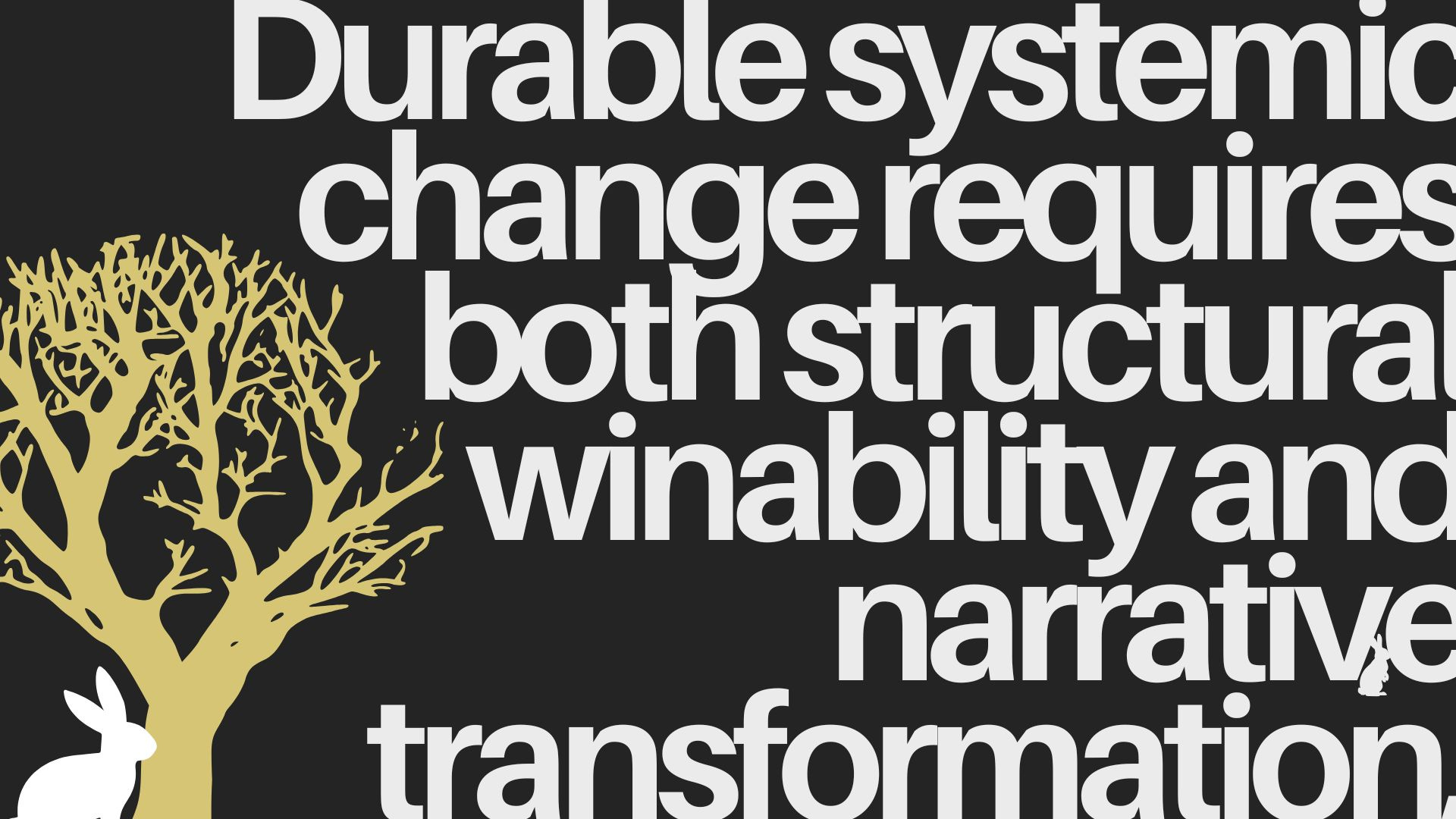
Winnable campaigns can stabilise the systems they seek to improve. Transformative campaigns can struggle to gain traction without structural leverage.
From a performance perspective, this is also a question of representation.
What is being staged?
Is the campaign presenting a problem that can be solved within the system?
Or is it exposing the system itself as the problem?
Those are very different dramaturgies, and they produce very different political possibilities.
The Watership Index is an attempt to bring these dimensions together.
It evaluates campaigns across three areas:
Pragmatic winability, including decision-maker concentration, opposition strength, and policy pathways
Narrative and cultural power, including symbolic clarity, emotional resonance, and system challenge
Integration and durability, examining how these dimensions interact, and whether a win produces lasting change or reinforces the status quo
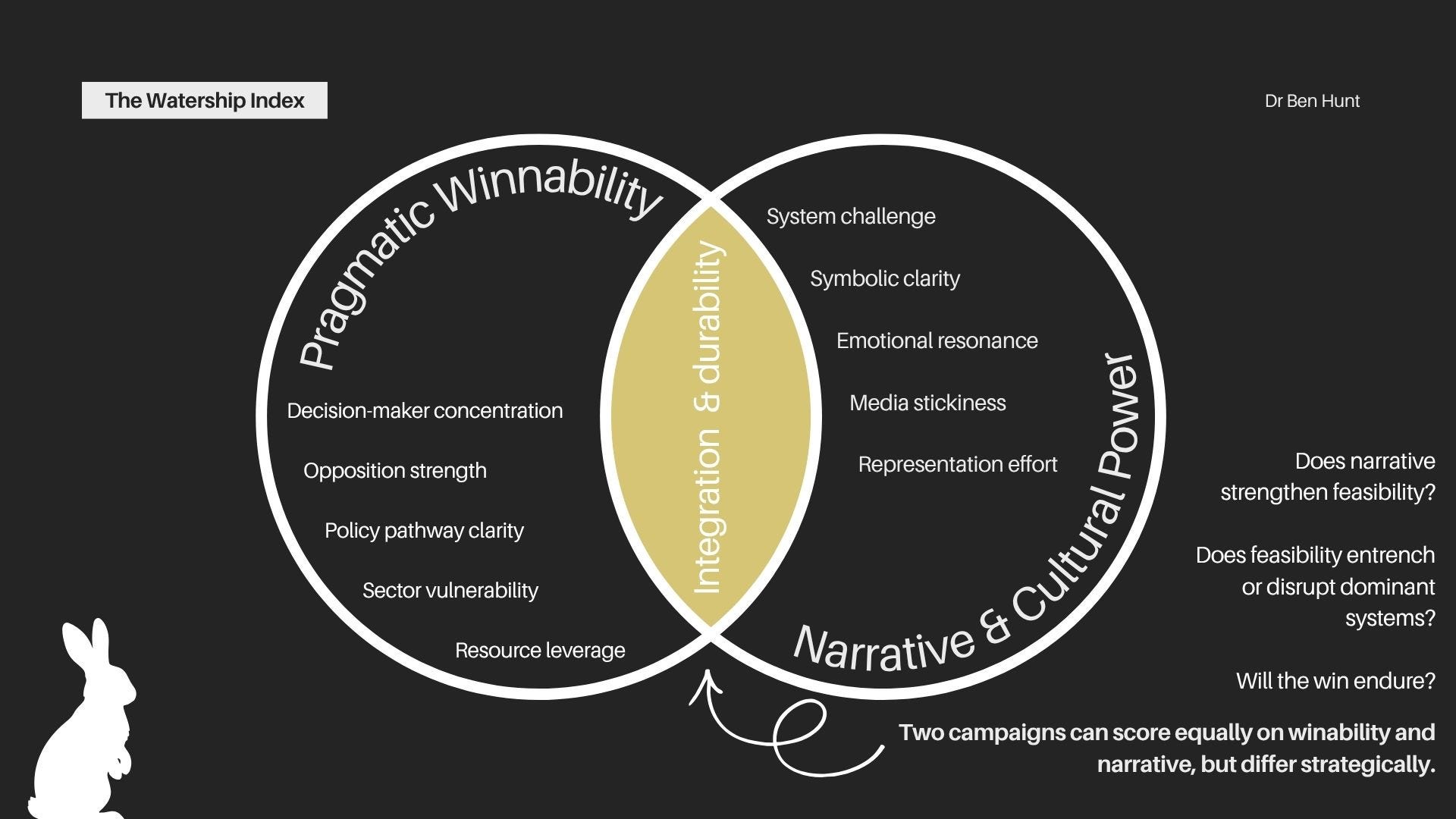
When viewed through this lens, campaigns begin to look less like isolated interventions, and more like performative acts within a wider narrative field.
Some campaigns reduce harm within existing structures.
Some prevent harmful structures from emerging.
Some actively delegitimise practices altogether.
These are not just strategic differences. They are different ways of staging the problem of animal exploitation.
The question, then, is not simply which campaign is “best”.
It becomes:
What story is this campaign telling?
What kind of world does that story make imaginable?
What does it make harder to imagine?
This weekend’s presentation felt like an important step in that process.
It sparked conversations across disciplines.
I spoke with researchers navigating the tension between tractability and the moral drivers that sustain activism. With artists interested in how creative interventions might take a more central role in campaigning. And with narrative-focused thinkers who were keen to see how the Index might be developed further.
Those conversations were generous, challenging, and energising.
They have already begun to shape how I’m thinking about the next stage of this work.
This presentation was not intended as a finished framework.
It was the launch of the Watership Index as a provocation.
A response to a strategic landscape that is often dominated by tractability alone.
The aim now is to continue developing this into a more fully realised report, one that can be taken up and applied by organisations, campaigners, and activists; within animal advocacy, and potentially beyond it.
This is where the connection to performance becomes most explicit. Narrative is not only about persuading audiences. It is also about sustaining movements.
In performance, meaning is not only conveyed, but felt, embodied, and repeated.
The same is true in activism. Narratives shape how people stay, not just how they arrive.
And this leads to a more difficult question.
What about liberation?
Many strategic frameworks avoid this, focusing instead on what is tractable or measurable. But from a performance perspective, this risks narrowing the horizon of what can be imagined.
If campaigns continually stage exploitation as something to be improved, rather than something to be dismantled, then the limits of the system remain intact.
The Watership Index does not resolve this tension. It makes it visible.
Because every campaign does more than produce an outcome.
It performs a version of reality.
If you’re working on campaigns and want to explore how this kind of thinking might apply in practice, please get in touch. I’d love to keep this conversation evolving.
Thanks for reading,
Ben
Very interesting presentation. Thank you. I hope one day there will be an opportunity to meet, watch your presenation, and discuss strategy!