

Hello,
I’ve been sitting with a recent conversation I had with Jen Armstrong and Sue Joyce from Animal Rights Choir, which I released on the podcast last week (listen here), and it’s stayed with me in a way that feels both grounding and quietly radical.
In a movement often defined by urgency, outrage, and exposure, there was something profoundly different in the space they are cultivating. Not softer in impact, but different in texture. Slower. Collective. Sustained.
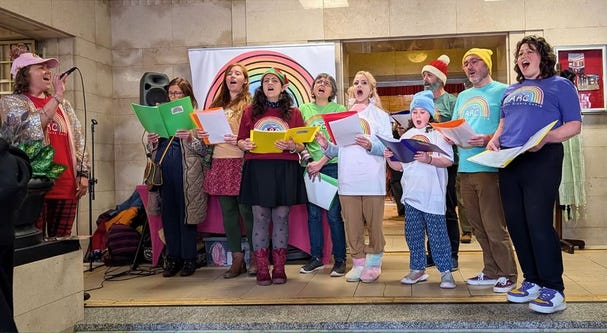
The voice as a collective body
One of the most striking elements of the conversation was how the choir reframes voice.
In performance and activism, voice is often individualised. The speaker, the protestor, the witness. Even in performance, we are trained to project, to be heard, to carry meaning outward.
But in the choir, voice becomes something else:
It is shared, not owned
It is relational, not expressive in isolation
It is built through listening as much as sounding
This has deep implications for how we think about advocacy.
In many ways, the animal rights movement struggles with voice. Who speaks for animals? How do we avoid appropriation while still confronting injustice? How do we move beyond speaking about animals to speaking with a sense of them?
The choir does not resolve this tension, but it shifts it.
Rather than positioning the human voice as a substitute for the animal, it becomes part of a collective field of feeling. A resonance. A holding space.
This is not representation. It is attunement.
Beyond persuasion, towards participation
Another thread that stayed with me was how the choir operates outside the usual logics of persuasion.
There is no immediate demand. No clear call to action in the conventional sense. No attempt to “win” an argument.
Instead, what emerges is:
A space people enter, rather than a message delivered to them
An experience that unfolds over time, rather than a moment of impact
A form of participation that does not require prior knowledge or ideological alignment
This feels particularly important when we think about the limits of traditional campaigning.
Much of advocacy is built around:
clarity
urgency
behavioural change
But what the choir offers is something closer to:
presence
shared experience
emotional alignment
This does not replace strategy. But it expands what we understand as effective.
It asks whether transformation might sometimes begin not with information, but with feeling alongside others.
Sustaining the movement
There is also something deeply practical here, even if it does not appear so at first glance.
Movements do not only fail because of lack of strategy. They also fracture through burnout, isolation, and emotional exhaustion.
The choir operates as a form of infrastructure for care:
a regular gathering point
a shared practice
a space where grief, hope, and frustration can be held collectively
In performance terms, this is pivotal.
We often talk about performance as intervention, disruption, spectacle. But what about performance as maintenance? As continuity? As a way of keeping people in the work?
There is a quiet durability to singing together that feels politically significant.
The aesthetics of sincerity
What I really admire about the choir format is the aesthetic.
No irony. No distancing. No attempt to intellectualise the emotional core of the work.
Just sincerity.
That can feel risky. Especially in activist spaces where credibility is often tied to sharpness, critique, or strategic clarity.
But sincerity, when held collectively, does something different:
it lowers defences
it invites participation
it creates a sense of shared vulnerability
This is not naive. It is a different kind of rigour.
One that takes seriously the emotional and relational dimensions of change.
What this means for performing animal rights
This conversation has shifted something in how I think about performance in the movement.
Not as a single mode, but as a spectrum:
from disruption to holding
from spectacle to gathering
from persuasion to participation
The choir sits firmly in the latter.
And perhaps that is where its strength lies.
In a landscape of images, arguments, and interventions, there is something quietly radical about a group of people coming together to sing.
Not to convince.
Not to confront.
But to feel, together, in a way that might make change possible.
If you haven’t come across Animal Rights Choir yet, I’d really recommend spending some time with their work. Even get stuck in!
More information can be found on their website: animalrightschoir.com
And I’d be curious to hear your thoughts:
Where do you see collective, participatory practices fitting within the movement?
“There is something deeply practical here,” to quote you back to yourself.
I have been thinking these past days that this is a turn the movement could take - to build more participation, and power.
It’s an insightful blog, and a brilliant initiative by Susan and Jen. I’m particularly taken/persuaded by your section ‘The aesthetics of sincerity’. Moral authority, which is needed to persuade, is rooted in moral sincerity, and the choir provides that.
I was also stuck by: “The choir operates as a form of infrastructure for care … a space where grief, hope, and frustration can be held collectively.”
I’ve been very conscious of how the US civil rights movement used singing to sustain them, in protest, but also especially in doing the hard, boring, repetitive work of social movement organising.
The Ayni model is: political strategy, narrative strategy, organising strategy, and movement culture strategy. There’s too little said and too little attention given to movement culture strategy. Choirs everywhere would be an amazing start and catalyst.
Plenty of social movement theorists have written about how people join a movement for the cause, but stay for the relationships. And Cass Sustein writes a few pages about this in his book ‘How Change Happens’. That small groups provide a virtuous circle of radicalisation.
Small groups have been the backbone of movements forever. I’m trying to write about it for my first blog - slow progress as I’m new to writing.