

Hi friends,
Continuing this thread of reimagining animal rights activism through the lens of theatre history, today I’m drawing on two seismic figures in 20th-century performance: Jerzy Grotowski and Antonin Artaud.
Their approaches couldn’t be more different in form, but both share an unflinching belief in the power of embodied presence, and a commitment to theatre as a site of truth, not just representation. And both continue to haunt the edges of activist performance today; where the body carries more than a role, more than an image. It becomes a medium of witnessing, rupture, and transformation.
Grotowski: training as radical encounter
For Grotowski, the actor’s body was not an instrument, it was the site of a sacred exchange. In his Poor Theatre model, everything unnecessary was stripped away: no costumes, no sets, no lights. What remained was the raw, sweating body: disciplined, vulnerable, charged.


His actors trained to release blocks, to surrender ego, to access something primal and essential. It was not about pretending; it was about offering.
This is especially relevant when we consider how animal rights activists and performers embody other beings. Grotowski’s work reminds us that this is not mimicry. It’s not about “acting like” a cow or a fox. It’s about uncovering what is already shared: breath, fear, flesh. And submitting to the emotional and physical discipline required to access it without appropriation.
In protest, this might look like:
Endurance-based actions where the activist’s body becomes site and symbol (e.g. vigils, fasts, long-form durational performances)
Physical preparation for activism that centres discipline, honesty, and vulnerability
Training the body not to “perform animal,” but to host emotion, reveal complicity, and hold space
Artaud: cruelty as awakening
If Grotowski offers us the discipline of presence, Artaud gives us the violence of revelation.


In The Theatre and Its Double, Artaud famously called for a “theatre of cruelty”, not cruelty against the performer or audience, but a theatre that shatters illusion, burns through apathy, and reaches the audience on a visceral, non-rational level.
In many ways, this aligns with the goals of animal rights activism: to break through conditioning, to expose a system most refuse to see, to bring the body back into ethical alignment.
But there are cautions here. Artaud’s extremism often courts aestheticised suffering, and in the context of animals, who cannot consent, cannot perform, cannot represent themselves, this becomes ethically complex.
Still, what Artaud offers is an understanding of theatre as ritual, force, presence. He asks: what happens when we move past words? What happens when we allow our performance to disturb, to violate comfort, to become necessary rather than pleasing?
Towards an ethics of embodied advocacy
Bringing Grotowski and Artaud into animal rights isn’t about imitating their practices. It’s about learning from what they made possible:
A theatre of truth, not illusion
A performance rooted in flesh, not narrative
A body that becomes a witness, a site, and a tool of disruption
The challenge is to hold this intensity without slipping into spectacle or self-importance. To train and offer the body not as saviour or surrogate, but as a bridge between the human and nonhuman, the seen and unseen, the system and its undoing.
Where things are heading: talks, tools, transitions
I’ll be speaking at VARC: Vegan Animal Rights Conference in Manchester, March, sharing new work on campaign strategy, narrative potency, and movement design. My talk, From Policy to Performance: Rethinking Campaign Strategy through the Watership Index, will introduce a tool I’ve been developing to help campaigns align abolitionist ethics with strategic feasibility.
The Watership Index is a framework for:
Choosing campaigns that are winnable and culturally catalytic
Bridging short-term reforms with long-term liberation goals
Designing movement narratives that resist fragmentation and resonate symbolically
It’s grounded in practice, research, and creative thinking. I hope to see you there!
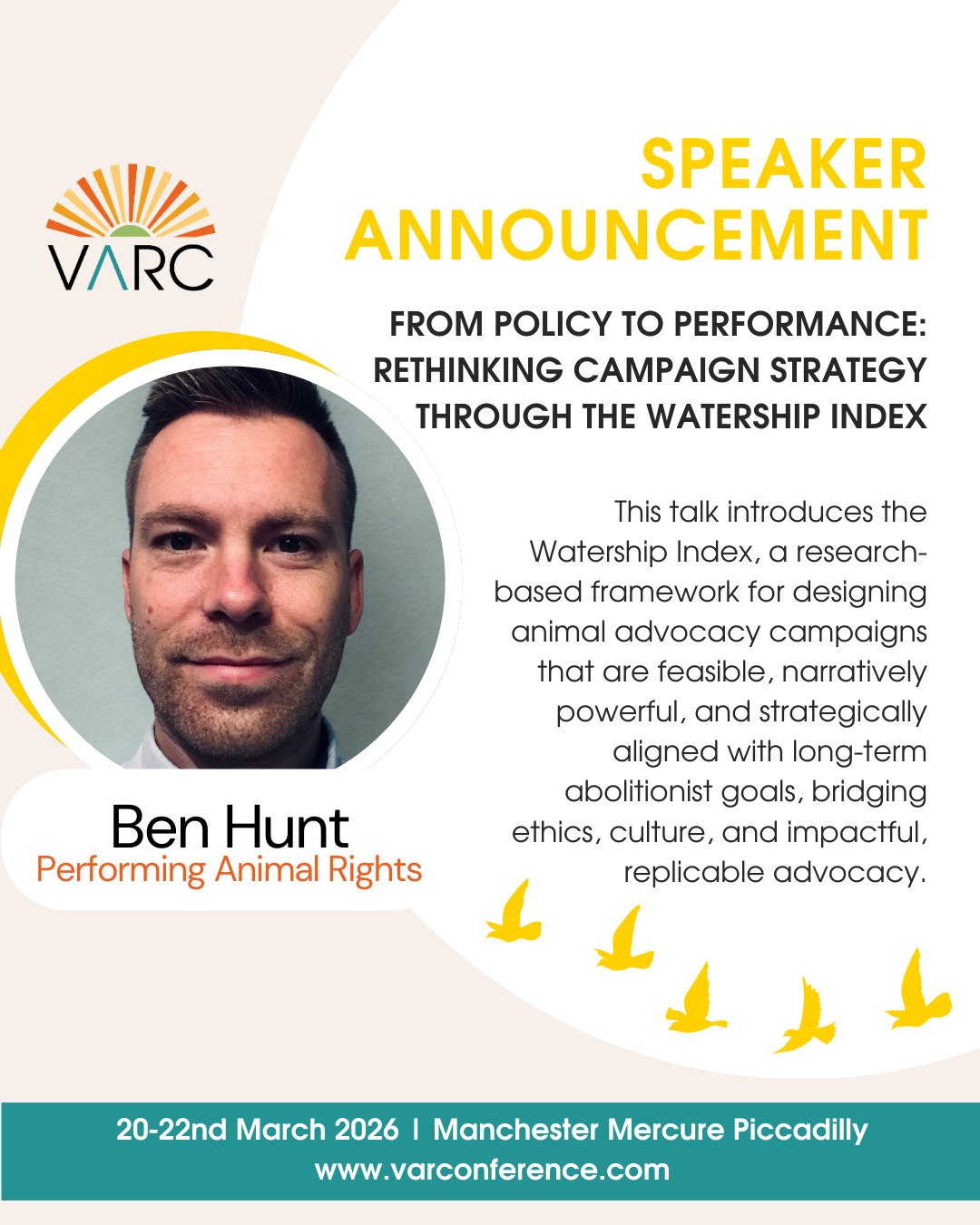
One last update…
After some reflection, I’ve decided that the performinganimalrights.org website will evolve.
Rather than housing a static archive, the platform will now centre on this newsletter and the podcast, with writing and reflections sent directly to your inbox. The blog, resources, and archive will still be available in some form, I’ll let you know as I reshape them. But for now, this feels like the most alive, generative space to grow the work.
Until next time,
Ben
Love this topic and really excited to read some more of your work. Heading to VARC this morning and looking forward to your talk. Have a great day!