

When we think about art and advocacy, certain forms immediately come to mind. Documentary film. Photography. Street theatre. Protest performance. Illustration. Social media campaigns. These are all important and have become familiar parts of the movement’s creative landscape.
Unexpectedly, though, I have found myself drawn somewhere else recently.
Recently I interviewed composer Keane Southard about his haunting and powerful work Requiem for Animals. You can listen here.

A requiem for animals
Requiem for Animals immediately struck me as something quietly radical, not simply because of its politics, but because of the artistic tradition it chooses to inhabit.
The requiem occupies a particular place within Western classical music. For centuries, composers have written requiems to mourn human death. Mozart, Verdi, Fauré, Britten and Duruflé all contributed works that have become central to the classical repertoire, offering audiences space to contemplate grief, remembrance and hope.
Keane asked a deceptively simple question.
Why has nobody written one for animals?
The question feels obvious once it has been asked. We inhabit a world where billions of nonhuman animals die every year through industrial agriculture, where species disappear at unprecedented rates, and where entire ecosystems continue to unravel. Yet culturally there are remarkably few rituals through which those losses are collectively acknowledged. We count them. We investigate them. We campaign against them. We rarely mourn them.
Keane described encountering research documenting the dramatic decline of wildlife populations over the past fifty years. What troubled him was not simply the statistic itself, but the inability of numbers to communicate their emotional weight. Music, he suggested, might achieve something that data alone cannot. It might create an experience rather than merely convey information.
Listening to him speak, I realised that what moved me most was not simply the composition, but the cultural claim it was making. Writing a requiem for animals quietly insists that nonhuman lives deserve the same artistic seriousness that we have historically reserved for human loss.
Beyond illustration
It also made me think back over many of the conversations I’ve had this year.
When Gemunu de Silva spoke about Industry Standard, he wasn’t interested in producing another documentary. Instead, decades of undercover recordings from animal industries became an experimental sonic artwork. The recordings remained evidence, but they also became music, asking audiences to listen differently.
My conversation with Brittany from the Protego Foundation pointed in another direction altogether. Rather than creating entirely new activist spaces, Protego enters existing cultural worlds, whether Harry Potter, Wicked, or Game of Thrones, inviting audiences to extend the ethical values they already celebrate in fiction into everyday life. The campaign begins inside culture, rather than standing outside it asking to be noticed.
At the Arten Festival in Switzerland, I found myself surrounded by artists who similarly refused to separate contemporary art from animal liberation. Performances unfolded alongside rescued horses. Poetry was read amongst ducks and hens. Rituals were held with pigs. An inflatable rasher of bacon became a collaborative artwork covered in hopes for a gentler future. None of it felt like art illustrating activism. It felt like culture itself being reimagined through an abolitionist lens.
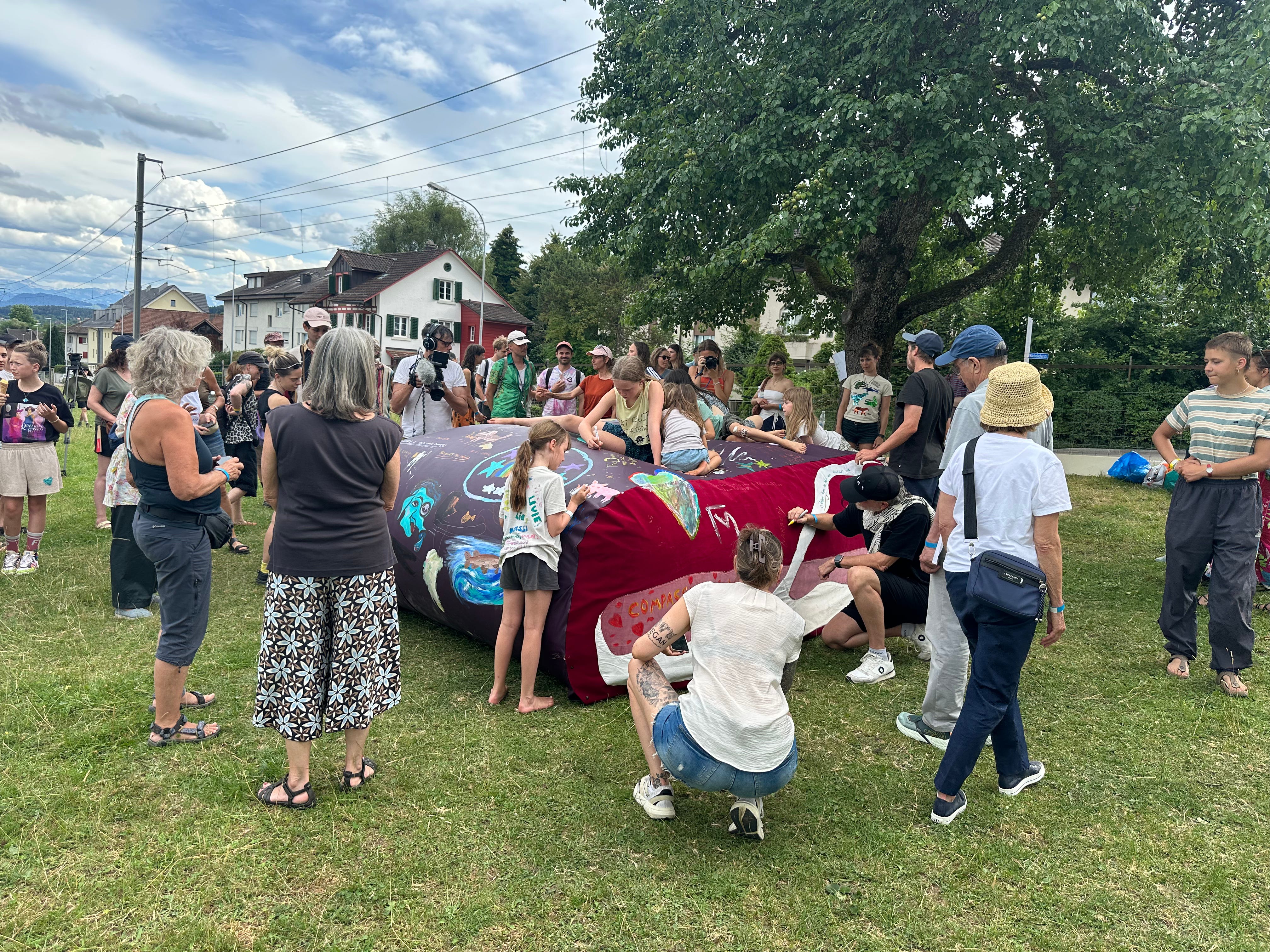
Viewed individually, these projects seem remarkably different. Yet together they suggest something rather exciting. Perhaps we are beginning to witness the emergence of an artistic tradition that takes nonhuman animals seriously, not simply as subjects, symbols or metaphors, but as beings whose lives deserve sustained cultural attention.
Reimagining the canon
For a long time, nonhuman animals have certainly appeared within high art. They populate paintings, operas, ballets, literature, sculpture and symphonic music. Yet they have often appeared in service of human concerns. The fox symbolises cunning. The lamb innocence. The horse nobility. The whale obsession. The bird freedom.
The nonhuman animal becomes meaningful because it tells us something about ourselves.
What interests me about the work emerging now is that the direction appears to be reversing. The nonhuman animal is no longer simply representing humanity.
Humanity is being asked to reconsider itself through the reality of the animal.
That feels like a significant cultural shift. Rather than asking where animals fit within existing artistic traditions, artists are beginning to reshape those traditions themselves. A requiem becomes a requiem for animals. A gallery exhibition becomes a meditation on speciesism. A fan convention becomes a site of ethical reflection. Contemporary art begins asking questions it has too often overlooked.
Perhaps this is how cultural change begins.
Art first, advocacy always
One moment from my conversation with Keane particularly stayed with me. He spoke about resisting the temptation to sacrifice artistic integrity for political messaging. If the composition only functioned because of its activism, then, in his view, it would ultimately become weaker both as music and as advocacy. The work first had to succeed as music. Only then could its ethical questions resonate fully.
I suspect that observation extends far beyond classical music.
It applies equally to theatre, visual art, literature, dance and performance. Some of the most compelling activist art I’ve encountered has never felt like propaganda. Instead, it has trusted the artistic form itself. Rather than reducing complexity, it has deepened it. Rather than simplifying ethical questions, it has created space for audiences to dwell within them.
Perhaps that is one of the great strengths of high art.
It is rarely in a hurry.
A requiem asks us to sit with grief.
A gallery asks us to linger with uncertainty.
A novel asks us to inhabit another perspective.
An installation invites participation rather than immediate judgement.
These forms operate on a different timescale. They cultivate reflection. They shape memory. They alter cultural imagination.
Building the culture of liberation
Movements often speak about changing laws, institutions and behaviours. Those ambitions remain essential. Yet laws are rarely the first things to change. Long before legislation shifts, cultures begin imagining the world differently. The arts have always been one of the places where those new imaginaries are rehearsed.
Perhaps this is why I find myself increasingly drawn to these conversations.
Not because they replace campaigning or investigations, but because they remind us that liberation is also a cultural project.
If animal liberation is to become part of our shared future, perhaps it also deserves its own music, exhibitions, festivals, literature and artistic traditions. Perhaps these works are not simply advocating for animals. They are quietly constructing the cultural foundations upon which a more compassionate society might eventually stand.
Listening to Requiem for Animals, I found myself wondering whether we are witnessing the beginnings of that canon already.
Perhaps, one composition, one exhibition, one performance at a time, it is slowly being written.
Animal rights should always be seeping into any and every art form. It is our expression and our power! I'm grateful that you share these on your platform to connect us to more amazing artists.
The animals deserve all our creativity!
Speaking as someone who has worked as an animal rights artist for 12 years, I find this piece incredibly moving and heartening to read. Wonderful, inspiring words