

There are some big questions that feel surprisingly difficult to ask out loud.
One of those questions has been following me around since I started the ‘theatre meets activism’ research journey.
Does activist art actually need to be good art?
Hold onto your berets…
At first glance the answer feels obvious. Of course it does. We wouldn’t expect a novel to escape criticism simply because it promoted a worthy cause, nor would we judge a piece of music solely by the virtue of its lyrics. Yet when it comes to activist performance, I wonder if we sometimes suspend those instincts. We care deeply about the politics, we admire the commitment of the artists, and we recognise the urgency of the issues they are addressing. Critiquing the work itself can feel almost disloyal, as though aesthetic judgement somehow undermines political solidarity.
The more time I spend working within and alongside creative activism, however, the less convinced I become that this hesitation serves either art or activism particularly well.
Over the past few years I’ve encountered extraordinary performances within the animal movement. Some have been meticulously crafted works of theatre, music and installation. Others have been participatory workshops, street interventions, vigils and public actions where the emphasis lay far less on spectatorship than collective experience. Some have moved me profoundly through their artistic ambition. Others have inspired me politically while leaving me strangely untouched as aesthetic experiences.
What interests me is not identifying which of these are “better”. Rather, I have begun wondering whether we are asking the wrong question altogether.
Beyond the message
One recent conversation that has stayed with me came during my interview with composer Keane Southard, whose Requiem for Animals confronts humanity’s relationship with other animals through large-scale choral music. We were discussing the challenge of writing about slaughter, grief and industrial violence when he said something that has lingered with me ever since.
He told me he had no interest in writing ugly music simply because the subject matter was ugly. The work still had to be artistically compelling. He still had to believe in every note he wrote. Even when composing music that addressed immense suffering, he wanted audiences, performers and he himself to experience something that remained musically beautiful and artistically truthful.
I found that deeply revealing.
It would have been perfectly understandable if Keane had argued that aesthetics should become secondary once the politics were sufficiently urgent. After all, if the work exists to encourage reflection on speciesism, surely the ethical message ought to take precedence over artistic beauty.
Instead, he quietly refused that separation.
The music was not simply carrying the ethics.
The music was part of the ethics.
Its beauty was not an escape from violence. It became one of the ways violence could be encountered, reflected upon and mourned without reducing either the music or the animals to illustration.
The more I have thought about that conversation, the more I have realised it reaches far beyond composition. It asks something fundamental about activist art itself. Perhaps aesthetics are not the wrapping around political ideas. Perhaps they are one of the ways those ideas become meaningful in the first place.
When ethics become aesthetics
A recent article on posthuman aesthetics in applied theatre pushed my thinking even further. Rather than treating ethics as the content and aesthetics as the form, the authors argue that ethical relationships emerge through aesthetic practice itself. Participation, movement, embodiment, listening, responsiveness and collective creation are not simply techniques used to communicate political messages. They are the spaces in which ethical encounters are produced.
That distinction feels subtle, yet I think it changes everything.
Too often we speak about activist art as though there are two competing priorities. Either the work is artistically ambitious or it is politically effective. Either it is aesthetically beautiful or socially useful. The implication is that one must inevitably be sacrificed for the other.
Increasingly, I wonder whether that opposition is false.
If a performance seeks to cultivate care, then the way bodies move through space matters. The rhythm of an encounter matters. The dramaturgy matters. The invitation to participate matters. The silences matter. None of these are decorative additions sitting alongside the ethics. They are part of the ethics.
Form is never neutral.
Perhaps this is especially true within animal advocacy. If we are asking audiences to reconsider their relationships with other species, then the quality of that encounter cannot simply be measured by the correctness of the message. The experience itself matters. How attention is directed, how empathy is invited, how discomfort is held, how complexity is sustained, all of these are aesthetic decisions that shape ethical possibility.
The problem with worthy art
This leaves me with an uncomfortable thought.
Sometimes activist art is protected by the importance of its politics.
We’ve probably all experienced work where the issue being addressed feels unquestionably significant, yet the artistic experience remains strangely flat. The symbolism arrives exactly where we expect it. Characters become mouthpieces. The audience already agrees with the politics before the performance has even begun. We leave reassured that our values were correct, yet nothing in our perception has shifted.
Agreement is not the same as transformation.
One belongs primarily to cognition.
The other often belongs to aesthetics.
The performances I continue thinking about months or years later rarely do so because they presented an argument I had never encountered before. They remain with me because they reorganised the way I experienced time, space, grief, beauty or another living being. They made familiar ethical questions feel unfamiliar again.
Perhaps this is where performance possesses its greatest political strength.
Not because it tells us what to think.
But because it changes how thinking itself feels.
Participation as artistic practice
Of course, this becomes more complicated once we move beyond conventional ideas of theatre.
Much of the work I have written about over the past year would look quite strange if judged solely by traditional artistic standards. Community choirs, participatory workshops, installations, processions, vigils and public interventions rarely aspire towards polished theatrical perfection. They deliberately embrace unpredictability because participants, rather than professional performers, become central to what unfolds.
From the outside, such work can appear messy.
Does that make it weaker art?
I am beginning to think we have misunderstood where the artistry lies.
The posthuman aesthetics paper describes applied theatre practitioners not as people who abandon artistic craft, but as artists whose expertise lies in facilitating relationships. Reading a room. Creating trust. Knowing when to intervene and when to remain silent. Designing experiences where participants genuinely shape what unfolds rather than merely carrying out instructions.
None of that happens accidentally.
Participation requires rehearsal.
It requires dramaturgy.
It requires sensitivity.
It requires extraordinary artistic judgement.
Perhaps participation is not the opposite of artistic excellence.

Whose standards are we using?
The more I have sat with these questions, the more another problem has emerged. When we ask whether activist art should be “good”, we rarely stop to ask who decides what “good” actually means.
Theatre criticism has developed over centuries around particular ideas of excellence. We value originality, technical skill, dramaturgical coherence, emotional complexity and aesthetic innovation. None of these criteria are unreasonable. They help us distinguish work that is thoughtful, ambitious and accomplished from work that is careless or underdeveloped. Yet activist performance often asks something else of itself. It may prioritise accessibility over formal innovation, participation over virtuosity or political urgency over ambiguity. Judging every activist intervention by the standards of institutional theatre would therefore seem unfair.
At the same time, I am equally uncomfortable with the opposite position, namely that activist art should somehow be protected from aesthetic criticism because its intentions are virtuous. Good politics cannot become a substitute for artistic reflection. If we genuinely believe performance has the capacity to reshape how people understand animals, then surely we should care deeply about how skilfully that performance has been made. Poor dramaturgy is not redeemed by an important message any more than beautiful staging excuses unethical politics.
Perhaps the challenge, then, is not to abandon artistic judgement but to expand it. We may need richer ways of talking about quality that acknowledge the particular ambitions of activist practice. A beautifully crafted participatory workshop should be recognised for the sophistication of its facilitation. A community performance should not be dismissed because it lacks professional actors if its artistry lies in creating extraordinary relationships between participants. Likewise, a visually stunning production should not be exempt from political scrutiny simply because its aesthetic achievements are impressive.
The standards remain.
They simply become more plural.
Art as ethical practice
The posthuman aesthetics article encouraged me to think about this in a slightly different way. Rather than treating ethics and aesthetics as separate categories that occasionally overlap, the authors suggest that ethical relationships emerge through aesthetic encounters. Care is not simply something a performance talks about. It is something the performance does through its organisation of bodies, materials, movement and attention. Ethics is experienced rather than merely explained.
I find this enormously helpful because it dissolves a distinction I have often carried without realising it. I had unconsciously imagined ethics as the destination and aesthetics as the route taken to reach it. The performance carried a political message, while its artistic form simply made that message more engaging. Increasingly, I think that picture is far too simplistic.
If a piece of theatre asks us to care differently about another animal, then the rhythm of the performance matters. The pace at which revelation occurs matters. The atmosphere matters. Silence matters. Humour matters. Beauty matters. Participation matters. None of these are decorative flourishes. They shape the ethical experience itself. They determine whether audiences feel manipulated, invited, challenged or transformed.
This perhaps explains why certain performances continue to haunt us long after we have forgotten their arguments. Their politics have become inseparable from their aesthetic experience. We no longer remember only what the work wanted us to think. We remember how it reorganised our attention.
That feels particularly significant within animal advocacy, where so much campaigning understandably depends upon information. Statistics, investigations and evidence remain indispensable. Yet performance contributes something different. It creates conditions in which knowledge can become lived experience. The facts may remain unchanged, but the relationship between those facts and our own bodies shifts.
The aesthetics of liberation
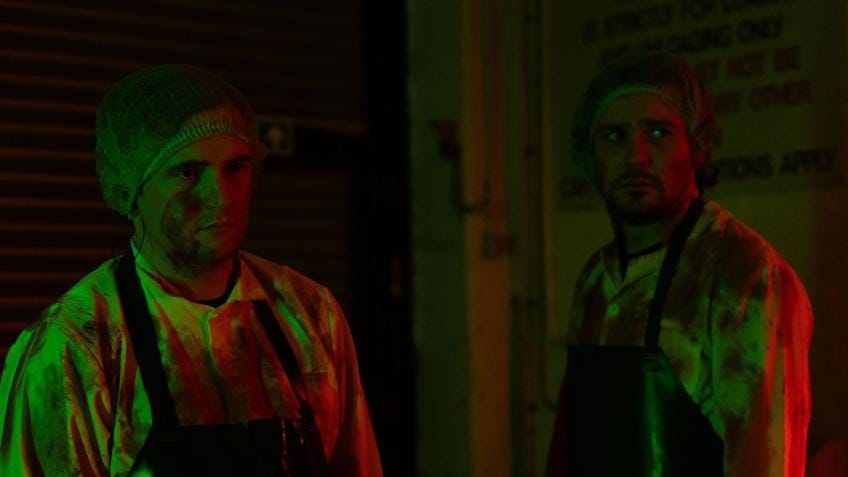
As I reflected on this, I found myself returning to many of the works I have written about throughout this newsletter over the past year. They are extraordinarily different from one another. A requiem for animals. A theatrical courtroom where animals prosecute humanity. A participatory installation built around an inflatable rasher of bacon. A drag cow disrupting assumptions about gender and species. A film following a hen escaping industrial agriculture. Artists attempting to inhabit the sensory worlds of earthworms, otters and kestrels. At first glance these works seem to have very little in common beyond their concern for other animals.
What connects them, I think, is not simply their politics.
It is their attention to form.
None of them rely solely on telling audiences that animals matter. Instead, they construct experiences through which audiences are invited to encounter animals differently. Sometimes that encounter is beautiful. Sometimes it is playful. Sometimes it is unsettling or quietly mournful. Sometimes it is deliberately unresolved. In every case, however, the ethical force of the work emerges through its aesthetic choices rather than existing independently from them.
That observation has left me wondering whether the animal advocacy movement occasionally undersells its own artistic ambitions. We often speak about creativity as though it were useful because it helps communicate campaign messages more effectively. Perhaps that relationship should be reversed.
Perhaps creativity is not valuable because it serves activism.
Perhaps activism becomes more ethically powerful because it takes creativity seriously.
Those two statements are not identical.
The first treats art as a tool.
The second recognises art as a way of knowing, feeling and relating to the world that politics alone cannot provide.
An unfinished question
I have not reached a settled answer to the question that opened this essay.
Does activist art need to be good art?
I suspect it does.
But not because activist artists should aspire to satisfy every convention of institutional culture, nor because beauty somehow matters more than justice. Rather, I think activist art carries a particular responsibility to think carefully about its aesthetic life because aesthetics shape the ethical encounter itself. The way a performance moves, listens, pauses, invites participation or creates beauty is not separate from its politics. It is one of the places where those politics become real.
Perhaps that is why I continue returning to works like Requiem for Animals. Keane Southard could have allowed the horror of industrial animal agriculture to dictate an equally harsh musical language. Instead, he insisted that the work should remain musically beautiful, that every note should possess artistic integrity despite the suffering it sought to confront. I no longer hear that as an aesthetic preference. I hear it as an ethical position. Beauty does not erase violence. It creates another way of bearing witness to it.
The more I explore performance within animal advocacy, the less interested I become in choosing between aesthetics and ethics. Increasingly, I think they are inseparable. The question is not whether activist art should be beautiful or political, participatory or accomplished. The more demanding challenge is to create work in which these qualities strengthen one another, where artistic excellence deepens ethical encounter and ethical commitment pushes artistic practice somewhere genuinely new.
Perhaps that is the kind of art animal liberation deserves. Not art that is excused because its politics are good, nor art that sacrifices politics in pursuit of beauty, but work in which aesthetics and ethics become impossible to pull apart.
Thank you for your deep thoughts. I have been plagued by the same question for almost all my life, and I strongly agree with your line of reasoning and your conclusions. I just wish to add one angle.
You mentioned pardoning bad art for its political merits. It is not only a common phenomenon; it is universal, and it seems to be part of our species-specific herd inheritance. It is not restricted to the arts, in fact, but we see it in all areas of human activity. A politician always speaks wisely (even if he/she talks bullshit or nonsense) if he/she is MY politician. A country is the best in the world, even holy, if it is my country. The baby is the most beautiful I have seen if it is my baby, etc. We divide the world into two: things that are mine and things that are not mine. Mine is the portion of the world that I am committed to: my herd, my tribe, my people, OUR opinions. All evaluations of quality are secondary to this division.
Aesthetics, on the other hand, is something universal. I don’t mean that specific aesthetic evaluations are universal, but that the aesthetic attitude looks for something in things that is above all specific manifestations of things, something “higher,” something inherently non-partisan, non-tribal, unselfish, but at the same time emotionally and/or intellectually powerful, irresistible, self-evident once experienced, in some sense true par excellence, the truest true.
Therefore, there is an inbuilt conflict between these two, the political and the aesthetic, the partisan and the universal.
If a political performance wants to create a strong aesthetic feeling and gain artistic recognition, its form must acknowledge the universal without giving the feeling that the universal is subordinated to the partisan. The universal and the partisan may well walk hand in hand, and indeed, some “partisans” fit much better in “the universal’s” hand than others.
But to do so, they must somehow converge in the now of the performance, so that the spectator (and the participants) experiences their union. In this union the whole is crucial, and defects will be pardoned if the whole is strong enough. In some cases the defects, or apparent defects, of the performance may even add to the total effect, as in a case when you are moved to tears by a not-quite-perfect violin solo by an octogenarian musician in the market square, with his likewise old, shabby dog by his side. There are lots of universals there for the one who is sensitive to them.
So, the question of the partisan and art is indeed complicated, and whether there is a conflict between them or not depends on everything; it is case-specific.
This came around at such an interesting time! I have been thinking about this as I recently had a conversation with someone where I was recommending an 'actually good vegan artist'. It sounds really judgemental! But I do find that sometimes, as much as the music is meaningful, the music makes it hard to listen. Thankfully this artist I was referring to was enjoyable not only as a vegan, but as a music lover. I wouldn't be embarrassed to share it with my non-vegan friends.
For me, if our key goal is to reach new audiences with art that shares our message - then we need to be making sure it is good! We need to make sure it is something that stays with people and they want to recommend to someone else and so on. There is a reason why certain political books are widely read, and some long forgotten. They are accessible and incredibly storytelling. It's the same with any other art form!
Great read, and really gave me some insight into how others are viewing this topic.