

One of the unexpected pleasures of recording the podcast has been discovering organisations that make me reconsider assumptions I didn’t even realise I held.
Recently I had the opportunity to speak with Brittany from the Protego Foundation, an organisation that describes itself as “animal rights meets a bunch of nerds.”
Which you can listen to (and others) at: performinganimalrights.org/podcast
On paper it sounds wonderfully simple. They build campaigns around Harry Potter, Wicked, Game of Thrones and other fandoms, inviting audiences to extend the ethics they already celebrate in fiction into their everyday lives.
Yet after listening back to our conversation, I realised the fandoms themselves weren’t what fascinated me most.
It was the strategy.
For years I’ve thought about creativity in animal advocacy largely in terms of production. How do we create better performances? Better exhibitions? Better campaigns? Better stories?
Protego quietly asks a different question altogether.
What if the most interesting work isn’t creating new cultural spaces at all?
What if it’s entering the ones that already exist?
Beginning with people’s passions
One of the things Brittany described was how quickly conversations happen at conventions. Visitors stop because they recognise Harry Potter, Wicked, or Game of Thrones. Five minutes later they’re signing a petition about vegan Butterbeer, animals used as convention props, or captivity. The conversation begins with something people love rather than something they feel guilty about.


That strikes me as a subtle but profound inversion of how animal advocacy often operates.
Much of our movement quite understandably asks audiences to step into our world. We invite people to screenings, demonstrations, talks, vigils, campaigns and outreach stalls. There is nothing inherently wrong with that. Those spaces remain essential.
Protego reverses the direction of travel.
Instead of asking people to come to animal advocacy, they bring animal advocacy into the places where people already gather. The convention is no longer simply a venue for outreach. It becomes part of the campaign itself.
That difference might seem small, but I think it changes everything.
People rarely arrive at a comic convention expecting to discuss animal ethics. Yet they already possess the emotional tools required for those conversations. They have cried over fictional creatures. They’ve celebrated liberation. They’ve condemned oppression. They’ve defended magical beasts, dragons, direwolves and talking goats.
The ethical imagination is already there.
The campaign simply asks where those ethics go when the credits roll.
Art as infiltration
The same thought returned to me when I stumbled across the work of SPECIESISM.WTF.
Their approach looks very different on the surface, yet I found myself recognising a similar logic. Rather than building campaigns around fandom, they deliberately position speciesism inside contemporary art itself. Their work argues that galleries should be places where speciesism is confronted, creating visual interventions that mirror the treatment of nonhuman animals through human bodies while insisting that nonhuman animals remain at the centre of the conversation.
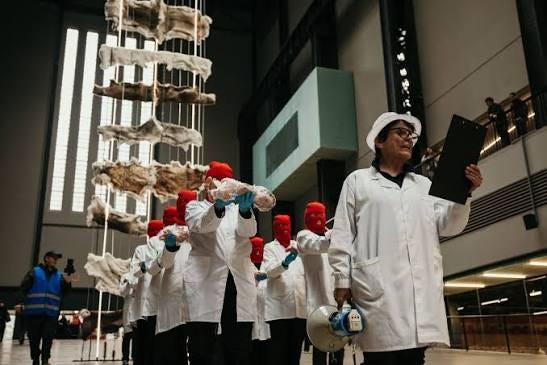
Again, what interested me wasn’t simply the imagery.
It was the choice of location.
The gallery is not just somewhere the work happens to be displayed.
The gallery is part of the argument.
Visitors enter expecting specific contemporary art. Instead they encounter activist art of slaughter, fishing, dairy or confinement presented through a visual language they already recognise as worthy of contemplation.
No one is being asked to leave the art world and attend an activist meeting.
Instead, the activist meeting has become an exhibition.
That feels like a subtle but important distinction.
Borrowing the language of culture
Theatre has always understood this.
Brecht rarely invented stories from nothing. Shakespeare borrowed relentlessly. Boal worked with situations audiences immediately recognised. Good theatre often begins with familiarity before gradually unsettling it.
Perhaps animal advocacy can do something similar.
Rather than constructing entirely separate cultural worlds, perhaps we can learn to inhabit existing ones more imaginatively. The theatre, the gallery, the cinema, the football stadium, the comic convention, the music festival, the literary world, each already possess its own language, rituals, communities and values. Entering those spaces doesn’t require us to dilute our politics. It requires us to become fluent in someone else’s culture.
Listening to Brittany, I was struck by how little time that translation sometimes takes. The campaign doesn’t persuade people that compassion matters. It assumes they already believe compassion matters. The real work is helping them recognise that the values they happily celebrate in fictional worlds might also belong in the real one.
Beyond communication
Perhaps this is why I’ve become increasingly interested in what I see as ‘cultural hacking’.
Not manipulation.
Not disguising activism.
Not sneaking politics into art.
Something much more collaborative than that.
It begins with respect for the communities that already exist. It recognises that galleries, fandoms, theatres and festivals are already places where people gather to ask questions about the world. Animal advocacy doesn’t have to interrupt those conversations from the outside. Sometimes it can simply join them.
The more artists, campaigners and organisers I meet, the more convinced I become that some of the most exciting work happening in our movement isn’t trying to invent new audiences.
It’s discovering that audiences have been waiting for us all along.
We simply needed to meet them where they already were.