

Augusto Boal famously described theatre as “a rehearsal for the revolution”. His point was not simply that theatre reflects political life. Rather, performance allows people to experiment with political possibilities before they exist in the world. The stage becomes a place where different futures can be tested, challenged and collectively imagined long before they become law.
Much of this newsletter has explored how performance reshapes our relationships with animals, through embodiment, storytelling, music, cultural intervention and artistic practice. Increasingly, however, I find myself asking a slightly different question. If societies are ever to become genuinely multispecies, where does that political transformation begin? Does it begin in parliament, through legislation and policy? Or might it begin somewhere much quieter, in theatres, galleries, festivals and performances where people are invited, however briefly, to inhabit a world organised differently from the one they currently know?
Two encounters recently pushed that question to the forefront of my thinking. The first was a fascinating panel at SXSW London imagining what a multispecies city might look like by 2050. Architects, designers and campaigners explored a simple but remarkably ambitious proposition. What if cities were designed not solely for humans, but as places consciously shared with foxes, pigeons, insects, bats and countless other species? What if an Animal Commissioner represented nonhuman interests alongside existing political institutions? Rather than treating animals as visitors or problems within urban environments, the panel invited its audience to imagine them as fellow citizens.
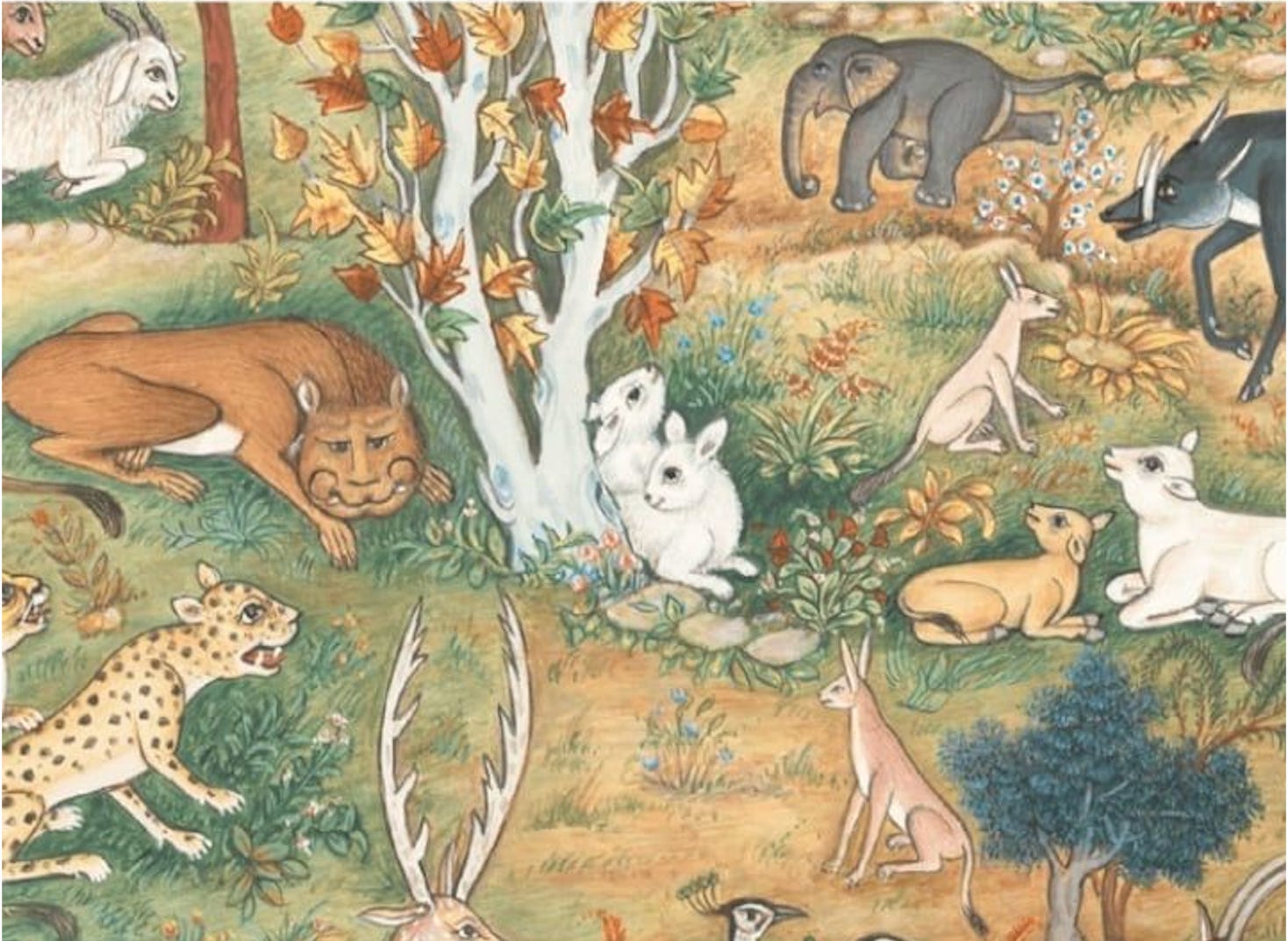
A few days later I found myself reading a play that was sent to me by a fellow theatre lover and activist: The Animals’ Lawsuit Against Humanity by Anson Laytner, a theatrical adaptation of a thousand-year-old Arabic fable in which domesticated animals bring humanity before a supernatural court, arguing that humans have violated their responsibilities towards other living beings. Throughout the trial, the ox, horse, sheep and donkey speak not as symbols or metaphors but as political subjects. They testify, challenge human assumptions and demand justice before King Bersaf and his court.
Although one imagines the future of urban governance and the other stages an ancient courtroom drama, they were attempting something remarkably similar.
Neither begins by asking what current law permits.
Both begin by asking what politics might become if animals were allowed to enter it.
Imagining another political community
Political theorists have long recognised that rights rarely emerge from legislation alone. Long before legal systems change, societies begin imagining different political communities.
Women were imagined as political citizens before they gained the vote. Children gradually became understood as subjects deserving protection before institutions emerged to safeguard their interests. Law often formalises changes that culture has already begun to rehearse.
Perhaps the same is true for other animals.
This is one of the reasons I continue returning to Zoopolis by Sue Donaldson and Will Kymlicka. Their work asks one of the defining political questions of contemporary animal ethics: if different kinds of animals already live alongside us in different relationships, domesticated, liminal and wild, then what kinds of political relationships ought to follow? Citizenship, sovereignty and denizenship become ways of rethinking animals not simply as beings we should avoid harming, but as members of shared political communities.
Yet reading Zoopolis alongside Boal, I found myself wondering whether another question sits just behind it.
If Zoopolis asks what multispecies citizenship might eventually look like, how do societies become capable of imagining such citizenship in the first place?
This is where Boal’s notion of rehearsal suddenly feels remarkably contemporary. Rehearsal is not prediction, nor is it policy. It is an experimental space where assumptions are temporarily suspended and alternative relationships become thinkable. Participants need not leave convinced. They simply leave having inhabited another possibility.
Perhaps multispecies politics requires exactly that.
Before cities redesign themselves around other animals, perhaps they first need opportunities to imagine what those cities would feel like. Before institutions recognise animals as political subjects, audiences may first need to encounter them as political participants through performance itself.
Staging justice
What fascinated me about The Animals’ Lawsuit Against Humanity was not simply that animals speak. Literature has allowed animals to speak for centuries. Aesop, Orwell, Adams and countless others have used talking animals to explore profoundly human concerns.
The animals do not merely speak. They sue.
That legal reversal quietly transforms the entire dramatic structure. Humans are no longer prosecutors, scientists or owners. They become defendants. The courtroom belongs, at least temporarily, to the animals. The ox describes the violence of agricultural labour. The horse recounts being forced into warfare. The sheep speaks of losing her children, her milk and ultimately her own body. Human representatives respond by defending dominion through intelligence, scripture, technology and supposed superiority. What unfolds is less a sentimental fable than a debate about power itself.
What struck me most was not whether such a trial could literally happen. It was what happened to me while watching it unfold in my imagination.
The question quietly shifted.
I was no longer asking whether humans should behave more compassionately towards animals. Instead, I found myself wondering what defence humanity could honestly offer if other animals were ever granted a political voice.
Performance had not changed reality. It had reorganised my relationship to it.
That, I think, is one of theatre’s quiet political powers. It allows impossible situations to feel temporarily ordinary. For the duration of the performance, the audience accepts that animals possess standing before the law. That imaginative leap may last only an hour, yet once it has been made it becomes surprisingly difficult to return entirely to previous assumptions.
Rehearsing the city
I found something remarkably similar taking place during the SXSW discussion, although through a completely different form.
The panel was not presenting a detailed blueprint for London in 2050. Instead, it invited its audience to imagine a city that had already accepted foxes, bats, pigeons and insects as legitimate inhabitants whose interests deserved political consideration. Once that imaginative leap had been made, familiar questions about planning, architecture and governance began to look rather different. Green corridors were no longer aesthetic improvements but routes of movement for multiple species. Public space ceased to belong exclusively to humans. Even infrastructure acquired new ethical dimensions.


Again, I found myself thinking about rehearsal.
Performance theorists often understand rehearsal as something far richer than preparation for a final production. It is a space in which relationships are explored, failures become productive and new possibilities gradually emerge through repeated experimentation. The finished performance matters, of course, but rehearsal is where different worlds are first tested.
Perhaps speculative politics functions in exactly the same way.
Neither the SXSW panel nor The Animals’ Lawsuit Against Humanity asks audiences to believe these futures already exist.
Instead, they ask whether we are capable of imagining them.
That distinction feels profoundly important.
Because imagination is rarely the end of political change.
It is very often the beginning.
Boal beyond revolution
Returning to Boal, I began to realise that his idea of rehearsal may have implications far beyond the political struggles he originally had in mind.
When Boal developed Forum Theatre and later Legislative Theatre, his concern was not simply with representation. He wanted theatre to become a place where democracy itself could be practised. Spectators ceased to be passive observers and became “spect-actors”, invited to intervene, question and reshape the action unfolding before them. Politics was no longer something watched from a distance. It became something collectively rehearsed.
That strikes me as a remarkably useful way of thinking about contemporary animal advocacy.
Much of our work understandably focuses on persuasion. We produce evidence, statistics, investigations and campaigns designed to convince audiences that change is necessary. These approaches remain essential. Yet theatre asks something slightly different of us. Rather than persuading audiences towards an existing political position, it invites them to inhabit political relationships that do not yet fully exist.
The distinction matters.
Persuasion asks whether people agree.
Rehearsal asks whether they can imagine themselves living differently.
Reading The Animals’ Lawsuit Against Humanity, I was not persuaded that animals deserve political consideration. I already believed that before opening the script. Instead, I found myself inhabiting a courtroom in which that political status had already been granted. For the duration of the play, I was no longer debating whether animals should have standing before the law. I was forced to consider what justice itself might look like once they did.
That shift feels subtle, yet profoundly important. The performance does not argue towards a conclusion. It begins from a transformed premise and asks the audience to explore its consequences.
The SXSW panel achieves something remarkably similar. It does not begin by asking whether London ought to become more accommodating to wildlife. It simply asks audiences to imagine a city that has already accepted this responsibility. Once that imaginative leap has been made, discussions about planning, housing, transport and governance unfold within an entirely different political landscape. The conversation changes because the world in which it takes place has already changed.
Increasingly, I find myself thinking that this is one of performance’s greatest political gifts. It allows us to live, however briefly, inside futures that remain unavailable elsewhere.
The limits of rehearsal
None of this means that performance is beyond critique. If anything, these examples reveal how difficult it is to imagine genuinely multispecies politics without slipping back into familiar assumptions.
One aspect of The Animals’ Lawsuit Against Humanity stayed with me long after I had finished reading. The court ultimately finds in favour of the animals. Their suffering is recognised, humanity is criticised and compassion becomes the guiding ethical principle. Yet the final judgement does not imagine liberation. Instead, it imagines a kinder form of stewardship. Animals remain under human care, albeit with greater responsibilities placed upon those who govern them.
I do not think this weakens the play. Rather, it reminds us that every act of political imagination remains shaped by the historical moment from which it emerges. We rehearse futures using the conceptual language available to us today. Even our most radical visions often carry traces of the worlds we are trying to leave behind.
Perhaps that is why rehearsal matters so much. Unlike policy, rehearsal is never finished.
Every new performance returns to the question from a slightly different angle. Every generation extends the horizon a little further. Yesterday’s impossible future becomes today’s political debate. Today’s debate becomes tomorrow’s institution.
This is precisely why culture matters.
Political theorists often describe legislation as though it were the engine of social change. Increasingly, I suspect it functions more like its archive. Laws tend to formalise values that have already begun shifting elsewhere, within literature, education, journalism, public conversation and, of course, performance.
Long before same-sex marriage became law, theatre explored queer lives with seriousness and dignity.
Long before ecological politics entered mainstream discourse, artists were asking audiences to reconsider humanity’s relationship with the natural world.
Perhaps multispecies politics will follow a similar trajectory.
Rehearsing a multispecies future
This thought has reshaped the way I think about many of the projects I’ve encountered over the past year.
Keane Southard’s Requiem for Animals does more than compose music about nonhuman suffering. It rehearses a cultural tradition in which animals become worthy of collective mourning.
Protego Foundation enters existing fandoms and asks audiences to extend fictional ethics into everyday life. Rather than inventing entirely new worlds, it rehearses compassion within worlds people already inhabit.
At Arten Festival I watched audiences transform an inflatable rasher of bacon into a place of play, conversation and shared imagination. Children climbed across what had once represented industrial violence. Visitors wrote hopes for a gentler future across its surface. The object itself had not changed. Its cultural meaning had.
Even the Protect the Wild performances I wrote about recently, dressing as foxes and gugas within election campaigns, begin to look slightly different through this lens. They are not merely publicity stunts or symbolic interventions. They rehearse a political world in which animals appear not as issues to be managed but as figures capable of entering civic life itself.


Viewed individually, these projects seem remarkably different.
Viewed together, they begin to resemble something else.
A series of rehearsals.
Not rehearsals of theatre.
Rehearsals of another political imagination.
I can only agree with the line of thought of this article. I lost belief in persuasion decades ago, upon seeing that almost no one, ever, changes his mind based on even excellent argumentation. All great changes of mind, almost always, are based on some personal experience, and the experiences can be imagined as well as real. There are lots of examples of this in literature, film, painting and other forms of culture.
This, in fact, is what I try to do in my two Octolution novels, Octolution 2027 and Sun City, available on Amazon (see my Linktree https://linktr.ee/erkki.kauhanen_eng). They are experiments of the mind, not pretending to be realistically achievable, but rather, see them as something to feed your thinking about animal rights.
Just shows that we can share the message in so many ways and the more we get people thinking in different environments, the sooner we can reach our goals. Always a joy to read!